
SALSA
More than a dance. A rhythm. A culture. A community.
Learn the steps, understand the music, and connect with a vibrant social dance world at San Tropez.
What Is Salsa?
Salsa is more than a collection of dance steps. It is a conversation between rhythm, melody, movement and connection.
Its musical roots reach through Cuba, Puerto Rico and other Caribbean traditions, while New York became one of the major places where those sounds came together, evolved and reached an international audience.
When you begin learning Salsa, something interesting happens: you stop hearing just one song and start hearing the individual instruments inside it.
The congas create one layer. The piano builds another. The bass anchors the music. The horns create excitement. Timbales, bongó and cowbell help drive the rhythm forward.
to hear
Salsa.
Musicality develops as you learn to recognize the rhythm, accents and changes happening inside the music.
The Sound of Salsa
Salsa music is built in layers. Each instrument contributes something different to the groove you eventually learn to dance.
CONGAS
Congas provide some of Salsa's most recognizable Afro-Caribbean rhythmic patterns.
BONGÓ
Bongó adds rhythmic texture and can become especially expressive as the arrangement builds.
COWBELL
The bell can give dancers a clear rhythmic reference, especially during more energetic sections.
TIMBALES
Timbales create fills, accents and dramatic musical moments that dancers can respond to.
PIANO
Repeating piano patterns help create the harmonic and rhythmic movement underneath the song.
BASS
The bass locks into the percussion and gives the music weight, movement and structure.
HORNS
Trumpets and trombones give Salsa its famous punch, excitement and big-band energy.
From Mambo to Salsa
Salsa has never stood still. Its sound has evolved across generations — from the explosive big-band mambo era to classic New York Salsa, romantic arrangements and today's Salsa Dura.
Press play and hear how the sound changed.
Mambo Legends
Big bands, powerful percussion, brass sections and the famous New York dance halls helped establish the sound and movement that would strongly influence Salsa.
Fania & Classic Salsa
In New York, musicians from across the Caribbean and Latin America helped create the hard-driving sound that became internationally associated with Salsa.
Salsa Romántica
Salsa took on a smoother, more romantic character. Arrangements became more polished and love stories moved to the centre of many songs, while the essential Salsa rhythm remained.
Modern Salsa Dura
Today's orchestras continue drawing from classic Salsa, mambo and Afro-Caribbean traditions while producing music for a new generation of dancers around the world.
Salsa did not simply replace these sounds. It absorbed and transformed them. A Salsa DJ can move from recordings made decades ago to music produced today — while the dance floor keeps moving.
Salsa
Can You Hear It?
One of the first breakthroughs in Salsa happens when you stop simply following steps and begin to recognize where those steps live inside the music.
Start with the slower example, follow the illuminated count, then switch to the faster example and hear how the same eight-count structure changes with the tempo.
Find the count
Salsa music is commonly counted in repeating phrases of eight beats.
In this exercise, the music starts from the beginning. The visual count waits for the actual musical phrase before showing the first 1.
Dancers normally step on 1, 2, 3 and 5, 6, 7 . Counts 4 and 8 are still part of the music, but are shown here as holds.
The numbers do not change when the music gets faster. What changes is the amount of time between each count.
Follow the Salsa count
Start by watching the numbers. Say 1, 2, 3... 5, 6, 7 with the music. After a few repetitions, stop looking at the display and see whether you can identify the next 1 yourself.
Watch and listen
Follow the illuminated numbers while listening to the slower track. Hear how the phrase repeats.
Count it yourself
Say the numbers aloud and try to recognize when the next phrase returns to count 1.
Change the tempo
Switch to Base 70 and notice how the same eight counts arrive more quickly.
With practice, you stop thinking about the numbers and begin feeling where you are inside the song.
Salsa On1 vs On2
Same music. Different relationship to the rhythm. Both styles use the same eight-count musical phrase, but the dancers emphasize different moments inside it.
Salsa On1
Commonly associated with LA-style Salsa and widely used as a beginner-friendly foundation for social dancing.
Salsa On2
Often associated with New York / Mambo timing and widely used by experienced social dancers around the world.
Build the foundation first. Then expand your musical vocabulary.
Our Salsa program develops a strong On1 foundation before students explore additional timing, musicality, styling, partnerwork and specialty training.
Neither timing is “better.”
They simply create a different relationship with the same music. As your listening skills improve, you begin to understand why different dancers prefer different timings.
From Your First Step to the Dance Floor
Everyone starts somewhere. At San Tropez, students can begin with the basics and keep progressing as far as they want — socially, technically, or on stage.

Your First Steps
Learn timing, weight transfer, basic turns and how to move comfortably with a partner.
- No partner required
- No dance experience needed
- Clear structured progression
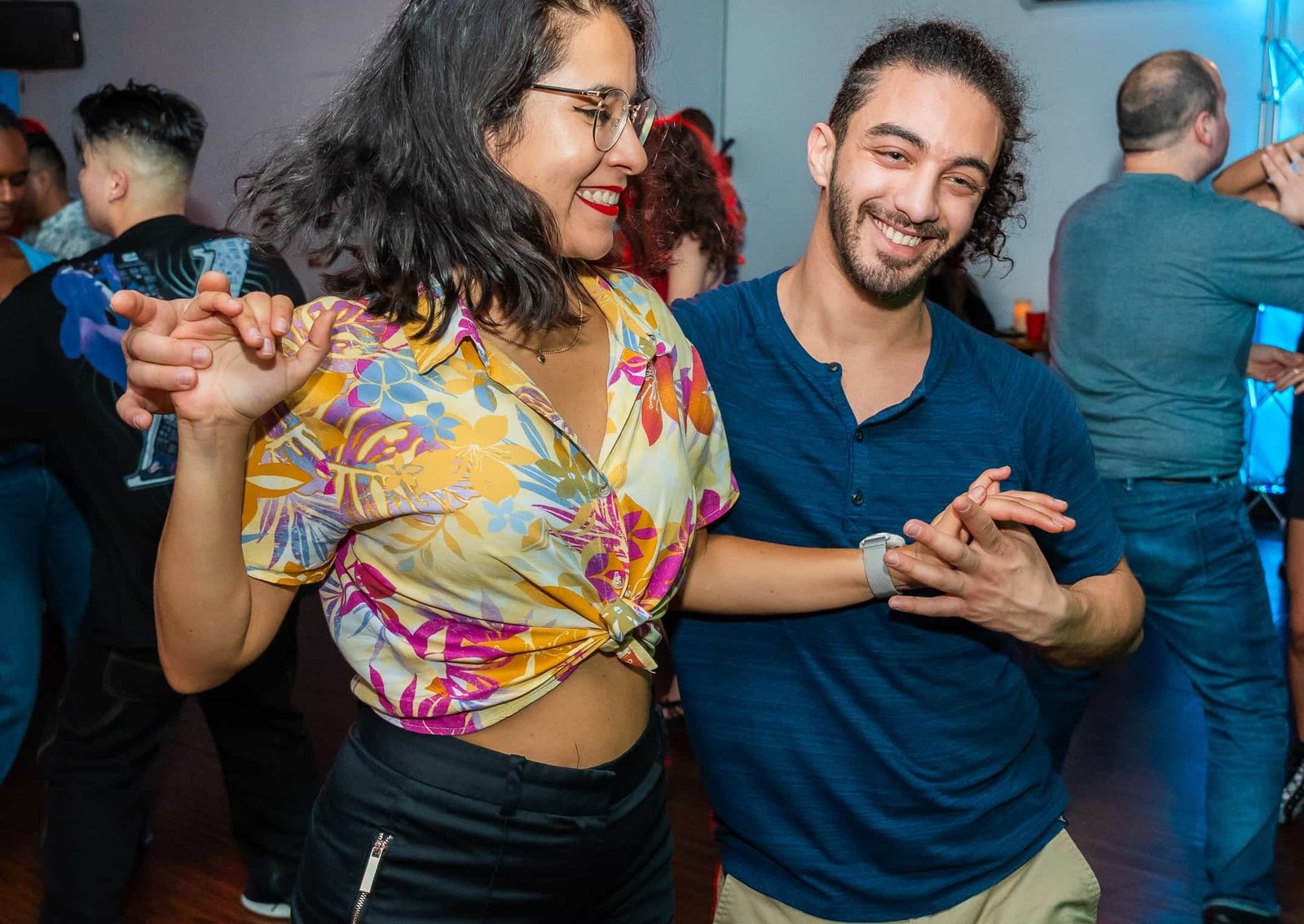
Become a Social Dancer
Start combining patterns, improving connection and feeling comfortable dancing with different partners.
- Partner connection
- Lead & follow technique
- Social dance confidence

Develop Your Technique
Explore musicality, styling, shines, body movement and more advanced partnerwork.
- Musicality
- Styling & shines
- Advanced partnerwork
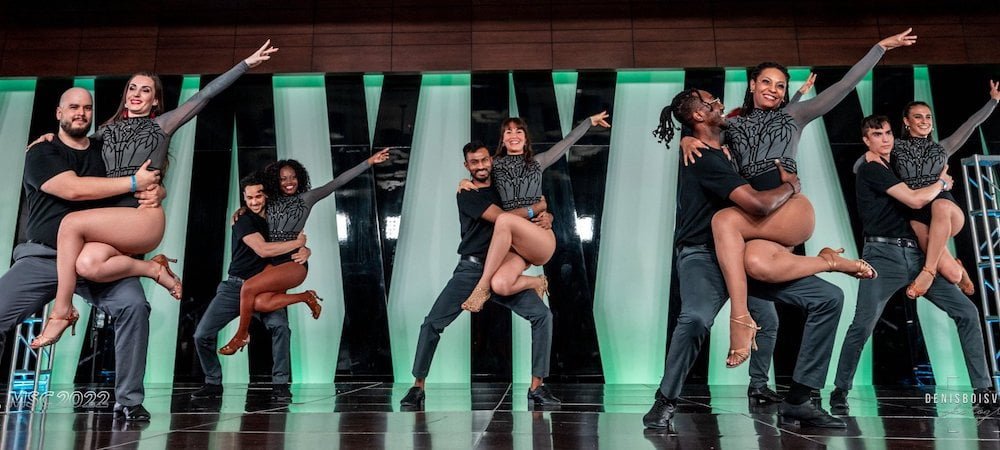
Take It to the Stage
For dancers who want more, San Tropez also offers choreography, team training and performance opportunities.
- Student teams
- Choreography training
- Performance & competition pathways
You don't have to become a performer.
Some students come to meet people. Some want a new hobby. Others fall in love with technique, performance or competition. The important thing is having room to grow.
More Than a Class. A Place to Grow.
Anyone can teach a combination. Developing a dancer takes more: structure, experience, musical understanding and the ability to guide students from their first class to wherever they want to go.
Teaching Montreal Since 1993
San Tropez has spent more than three decades introducing dancers to Salsa and helping them progress through every stage of their dance journey.
Structured Progression
Students are not simply given random combinations from week to week. Each level builds on the timing, technique and partnerwork developed before it.
Experienced Instructors
Our instructors are trained to teach dancers at multiple levels — from complete beginners to students preparing for choreography, performance and competition.
Complete Training
Salsa training can expand into styling, shines, body movement, musicality, Lead & Follow Technique, Dips & Tricks, On2 and other specialty classes.
Learn to Understand the Music
Technique matters, but Salsa becomes much more rewarding when you begin to understand rhythm, timing, phrasing and the music you are dancing to.
Beyond the Studio
Students can explore social dancing, choreography teams, performances, competitions and major dance events as their interests develop.
Your first teacher matters.
Strong fundamentals make everything that comes later easier. Good timing, clean technique and effective partner connection are much easier to build correctly from the beginning than to repair later.
A complete Salsa ecosystem
You may arrive wanting one beginner class and discover a much bigger world.
From the classroom to the Montreal Salsa Convention
San Tropez is part of a larger Salsa environment that includes training, performance, competition and international dance events. Students can experience Salsa far beyond the walls of the studio.
SALSA
CONVENTION
You don't need to know where Salsa will take you when you start. You simply need a place that gives you room to keep growing.
Your Salsa Level. Your Next Class.
Whether you're brand new or already dancing socially, our Salsa program gives you a clear path forward. Not sure where you belong? We offer free level evaluations.
Salsa Level 1
Start from the beginning and build strong fundamentals: timing, basic steps, turns and partner connection.
- Absolute beginners welcome
- No partner required
- Learn the basic Salsa count
- Foundational partnerwork
Salsa Level 2
Build a stronger vocabulary and become more comfortable combining patterns with different partners.
- Cross-body lead variations
- Turns & combinations
- Better lead & follow
- Social dance confidence
Salsa Level 3
Expand your movement vocabulary while improving technique, control and connection.
- More complex partnerwork
- Improved timing
- Technique refinement
- Intro to musicality
Salsa Level 4
Develop more control, speed and musical awareness while combining advanced partnerwork.
- Advanced combinations
- Musical interpretation
- Body movement
- Styling integration
Salsa Level 5
Refine advanced movement, musicality and partner connection for experienced social dancers.
- Advanced partnerwork
- Musicality & phrasing
- Speed & control
- Performance-quality technique
Go Beyond the Levels
Once your foundation is strong, explore specialized training designed to develop different parts of your dancing.
- Salsa On2
- Styling
- Lead & Follow Technique
- Dips & Tricks
- Body movement
- Choreography & teams
Not sure which level is right for you?
Book a complimentary level evaluation and one of our instructors can help place you in the appropriate class.
Salsa classes throughout the week
San Tropez offers Salsa classes from beginner through advanced, with multiple levels available throughout the week.
Because schedules can change seasonally, use the live schedule to see current class times, instructors and availability.
Start with 14 days of unlimited beginner classes.
Explore Salsa, Bachata, Merengue, Body Isolations and eligible beginner classes before deciding how you want to continue.
Salsa Questions? Start Here.
New dancers usually have many of the same questions. Here are the things that are useful to know before you walk into your first Salsa class at San Tropez.
No. Many students come to class on their own. Partner rotation gives students the opportunity to practise with different people and develop better lead-and-follow skills.
Yes. Salsa Level 1 begins with the fundamentals: timing, weight transfer, basic steps, simple turns and introductory partnerwork. You do not need any previous dance experience.
Our main Salsa progression develops dancers with an On1 foundation. As students advance, additional training can include On2, styling, musicality, shines, Lead & Follow Technique and other specialties.
You can begin learning the basic step and timing from your first classes, but becoming comfortable socially takes practice. Our program is designed as a progression, so each level builds on the technique and partnerwork developed before it.
If you are completely new to Salsa, begin with Level 1. If you already have dance experience, contact us for a complimentary level evaluation so we can recommend the appropriate class.
Wear comfortable clothing that allows you to move freely. For your first classes, clean indoor shoes that stay securely on your feet are fine. As you progress, proper dance shoes can make turning and movement easier.
The Intro Offer gives new students 14 days of unlimited access to eligible beginner classes, including Salsa Level 1 and other selected introductory classes. Your 14 days begin with your first attended class.
Yes. Students who want to train more frequently can choose an Unlimited membership and attend eligible classes at their level or below. Repeating fundamentals is often one of the fastest ways to become more comfortable.
Yes. Private lessons are available for students who want more individual attention or who want to work on specific areas such as timing, technique, partner connection, musicality or choreography.
Absolutely not. Many students simply want to social dance, meet people and enjoy learning Salsa. Performance teams and choreography opportunities are available for students who decide they want that experience later.
The fundamentals are very approachable when they are taught progressively. Like learning a language, Salsa becomes more natural as your movement vocabulary, timing and partner connection improve through repetition.
It can be both. Salsa involves continuous movement, coordination and body control, but it is also a social partner dance built around music, communication and connection with other dancers.
Talk to the San Tropez team.
Tell us about your experience and what you're looking for. We'll help you figure out the best place to begin.
What Kind of Salsa Dancer Are You?
Everyone connects with Salsa differently. Some people fall in love with the music. Others love the social energy, technique or performance.
Answer five quick questions, discover your Salsa personality and enter this month's San Tropez draw.
What attracts you most to Salsa?
You're at a Salsa party. What sounds most like you?
What would make you feel most successful?
Which Salsa class sounds most interesting?
Finish this sentence: “I want Salsa to...”
Your Salsa personality is ready.
Enter your details to reveal your result and complete your entry into this month's San Tropez draw.
The Music Lover
Your monthly draw entry has been received.
You're now entered in this month's San Tropez draw. If you're selected, we'll contact you using the email or phone number you provided.
We've sent your Salsa personality and monthly draw confirmation to the email address you provided.
Salsa isn't about becoming someone else. It's about discovering another way to move, connect and express yourself.