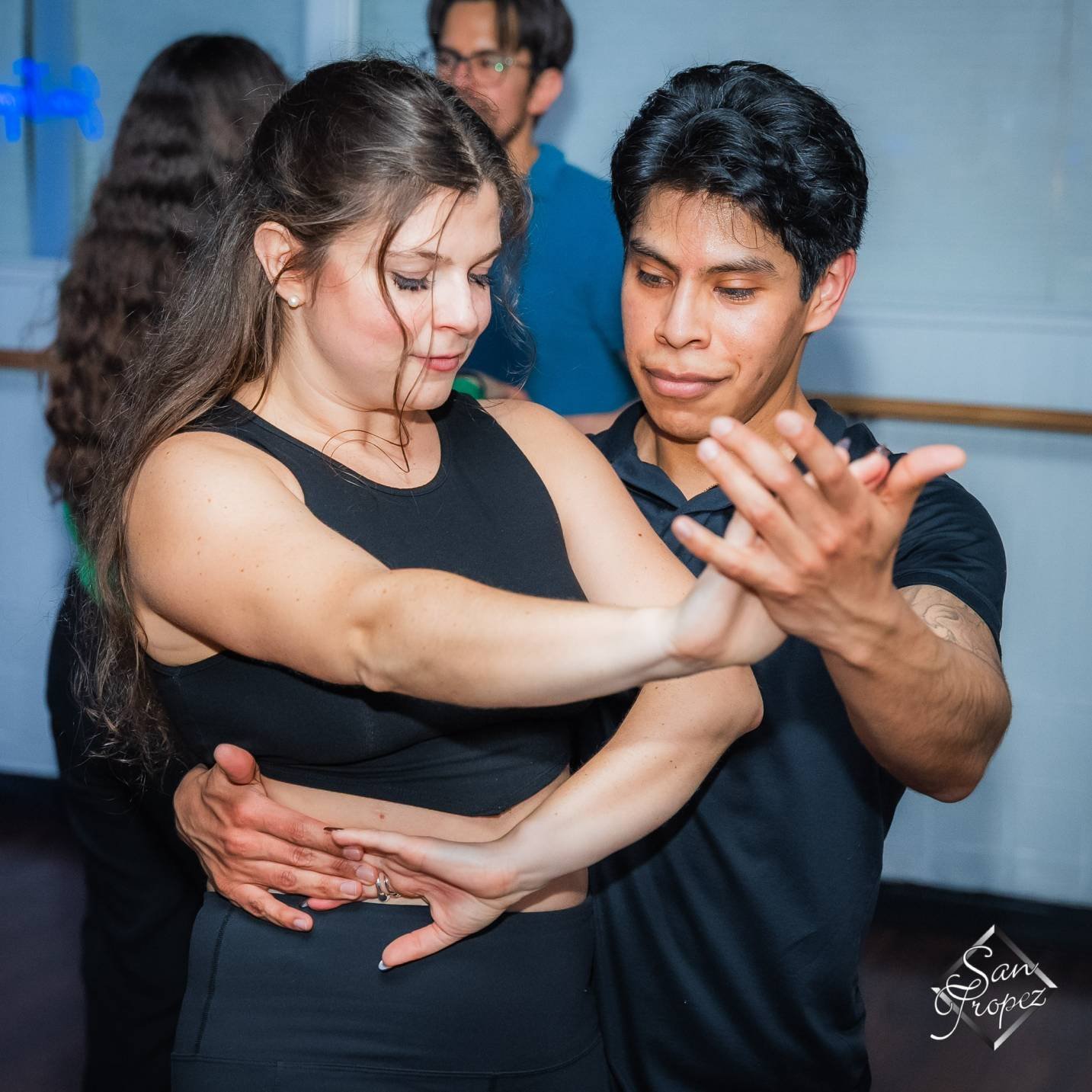

The Only Moves You Need
When your mind goes blank on the dance floor, the answer usually isn’t to learn more moves. It’s to make a smaller group of moves feel completely natural.
This one’s for the leaders: ever been dancing and suddenly realized you have absolutely no idea what move to do next?
You know you’ve learned dozens of moves in class. But somehow, when the music starts, your brain freezes, your legs lock and you find yourself trying not to smile foolishly while doing the bachata basic or salsa mambo over and over on loop.
First: there is nothing wrong with returning to your basic. A comfortable basic with good timing is always better than forcing a move you can’t lead clearly. But if the freeze happens often, there is a simple way to build a repertoire you can actually use.
It’s a technique Moris used at the beginning of his own dance journey, when his mind used to lock up too. Choose five movements you already know and practise putting them together. Repeat them until you can lead each one clearly and move smoothly from one to the next.
The important part is not simply remembering the order. You are training the transitions: how one movement ends, where your weight is, where your partner is, and how naturally the next lead begins.
Build your dance vocabulary in small, usable blocks.
Make five automatic
Choose five familiar moves. Practise clean leads and smooth transitions until you stop thinking about what comes next.
Add five more
Only when the first five feel easy, add another five and mix all ten in different orders.
Create a real repertoire
With fifteen dependable moves, you have enough variety to dance an entire song without chasing constant novelty.
How do you know when you’ve mastered them?
Try holding a conversation while you dance.
If you can talk without losing your timing, forgetting your moves or compromising your lead, those movements are becoming second nature. Your conscious attention is no longer consumed by remembering the choreography.
Now—and only now—add another five.
Why a smaller repertoire can make you look like a better dancer
Leaders often assume confidence comes from knowing a huge number of patterns. In practice, confidence grows when the movements you choose are dependable enough that you can pay attention to the dance happening in front of you.
Fifteen moves are more than they sound like
Once you have 15 movements you can lead confidently, you already have a solid repertoire to draw from. Repeat those movements two or three times in different combinations and you can comfortably get through an entire song—even a long one.
And repetition does not mean your dance has to feel repetitive. Change the order. Use a basic between patterns. Pause. Add a simple turn. Change direction. Respond to a musical break. The same vocabulary can create many different conversations.
That is the shift from reciting combinations to actually social dancing.
A simple practice plan for leaders
- Choose five moves you genuinely know.
Pick movements you can already execute without needing a teacher to remind you of every step. - Practise the transitions.
Don’t always repeat them in the same order. Move from A to C, C to B, B to E. Teach your brain that the moves are tools, not one fixed routine. - Protect your timing.
If a transition makes you rush, simplify it. A clean basic on time is better than a complicated move that pulls both partners off the music. - Test your attention.
Can you look around the floor? Smile? Listen to your partner? Hold a short conversation? Those are signs the movements are becoming automatic. - Add five only when you’re ready.
Growth comes from layering new material onto a stable foundation—not constantly replacing what you just learned.
It’s to make the moves you already know feel effortless enough that you can focus on the music, your partner and the experience you’re creating together.
What changes once the moves become automatic?
Once you can hold a conversation while fluidly leading 15 movements, you can start mixing and matching more freely, playing with the music and paying more attention to your partner.
You may also discover that you no longer feel pressured to perform something new every few seconds. You can let a movement breathe, enjoy a basic, repeat a pattern because it fits the music, or choose simplicity because it makes the connection feel better.
That is a very different kind of confidence from simply knowing more choreography.
Your challenge this week: choose your first five.
Write them down, practise them in different orders and see how quickly your dancing starts to feel calmer, clearer and more natural.
VIEW THE CLASS SCHEDULE →